

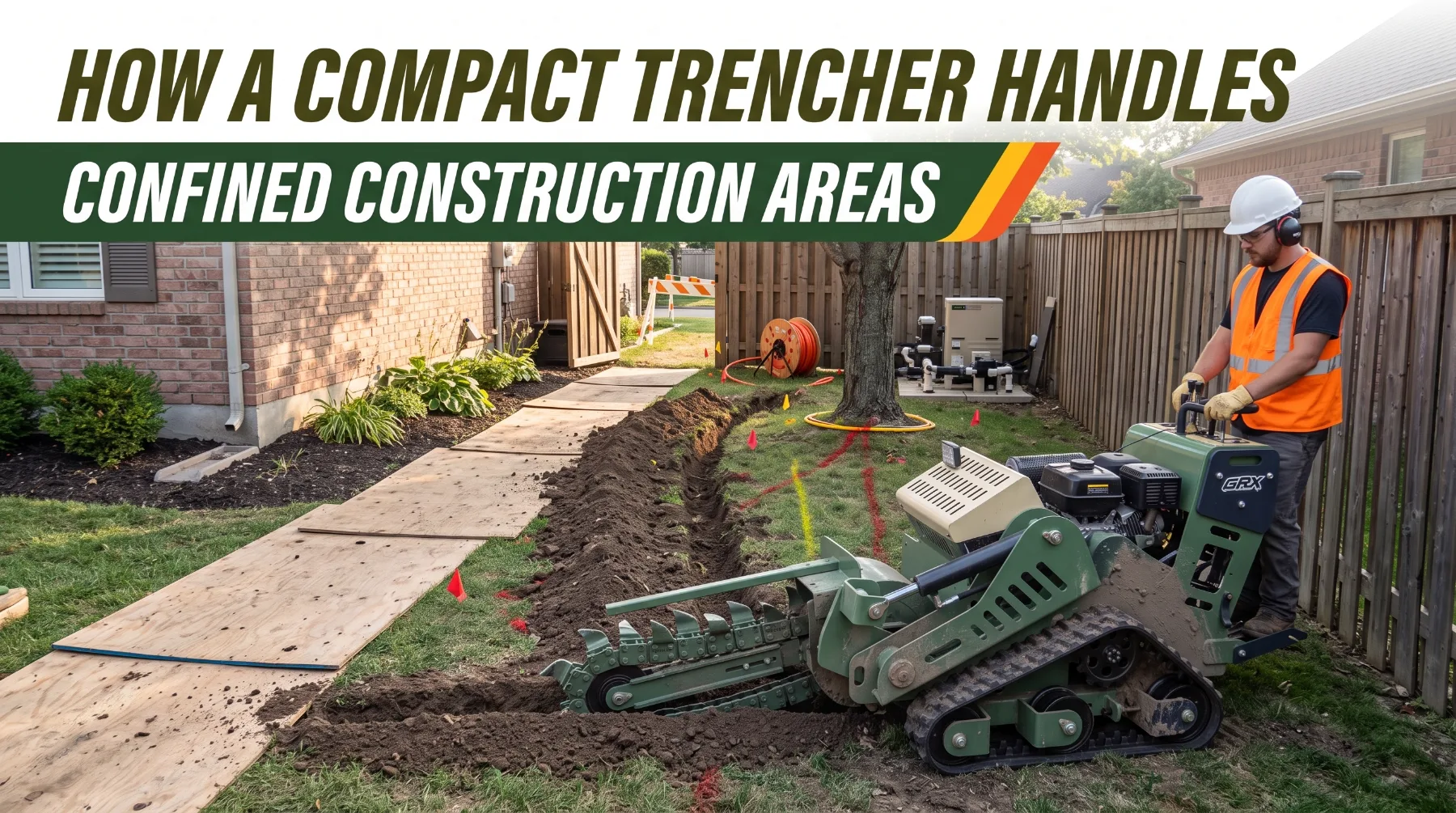
Utility trenching around homes and developed properties often requires equipment that can work between buildings, fences, landscaping, and other obstacles. A standard excavator may be too wide for narrow gates, while hand digging an entire route can require significantly more labor and time. A compact trencher can access restricted areas and create a narrow excavation while limiting disturbance to surrounding surfaces.
Machine width, cutting depth, chain configuration, and maneuverability all affect how effectively a compact trencher can work in confined spaces. Careful planning is still essential when the route passes near buried utilities, tree roots, foundations, landscaping, or other structures. Locating underground services, exposing crossings by approved methods, protecting travel surfaces, and maintaining the required trench dimensions help reduce unnecessary damage and improve control.
Before trenching begins, crews should confirm access dimensions, utility markings, required depth, soil conditions, and the location of nearby obstacles. Operators can then position the machine carefully and follow the planned route while maintaining appropriate clearance from utilities and structures. Matching the trencher to the available space and preparing the site properly can support faster trenching with less disruption to finished property.
Compact Dimensions Improve Access
Access is often the first challenge on a confined jobsite. Before trenching begins, the machine must reach the work area through gates, side yards, narrow paths, and spaces between structures. A compact trencher can make this possible on sites where larger equipment cannot enter. Walk-behind and ride-on trenchers are available in different configurations, including wheeled and tracked models, so consider how width, length, height, and weight affect access. Width determines whether the machine can pass through gates and narrow pathways, length affects turning and repositioning, height matters around decks, overhangs, and tree branches, and weight influences ground pressure and the risk of surface damage.
Measure the actual access route before choosing a machine. Check the gate opening, the narrowest space between structures, and overhead clearance along the entire path. Compare those measurements with the trencher's transport dimensions, including the boom in its travel or raised position. Leave enough clearance for the operator to move safely and control the machine without being forced against a wall, fence, or other obstruction. A machine that technically fits through an entrance may still be impractical if there is not enough room to operate it safely.
Protect the access route when working across lawns, pavers, or soft ground. Ground protection mats, plywood, or similar materials can help spread the machine's weight and reduce rutting or surface damage. Planning access and protecting vulnerable surfaces before the machine arrives can reduce restoration work and make the entire trenching operation more efficient.
Key takeaway: A smaller machine footprint makes it easier to reach restricted work areas, but measures every gate, pathway, and overhead clearance to confirm the machine fits the actual route.
Narrow Cutting Reduces Excavation
A trencher is designed to cut a narrow, continuous trench, which makes it well suited to confined projects involving cables, pipes, irrigation lines, and drainage systems. Because the machine removes only the soil needed for the installation, it can reduce excavation volume, keep spoil piles smaller, speed up backfilling, and limit the amount of landscaping or surface restoration required. These benefits are especially useful when working in narrow yards, established lawns, or other areas where space is limited.
Match the cutting setup to the installation requirements before starting the job. Check the required trench width and depth in the project specifications, then confirm that the trencher's boom and chain can produce those dimensions. A trench that is too narrow may not provide enough room for conduit, pipe, or required bedding material, while an unnecessarily wide trench creates more excavation, backfill, and cleanup work. Spoil placement also matters in confined areas. If the trencher's auger moves material to one side, plan that side carefully so spoil does not block walkways, damage landscaping, or fall back into the trench.
Check trench depth regularly as you cut, particularly when working across ground that rises or falls. Maintaining a consistent depth helps keep the installation within specification and is especially important for drainage lines that require a proper grade. Keep excavated spoil far enough from the trench edge to avoid placing unnecessary load on the trench walls. Good control of trench dimensions and spoil placement makes the excavation cleaner, easier to backfill, and more efficient from start to finish.
Key takeaway: A trencher's narrow cut removes only the soil the installation needs, so match trench depth and width to the specification and plan spoil placement carefully.
Useful Around Existing Structures
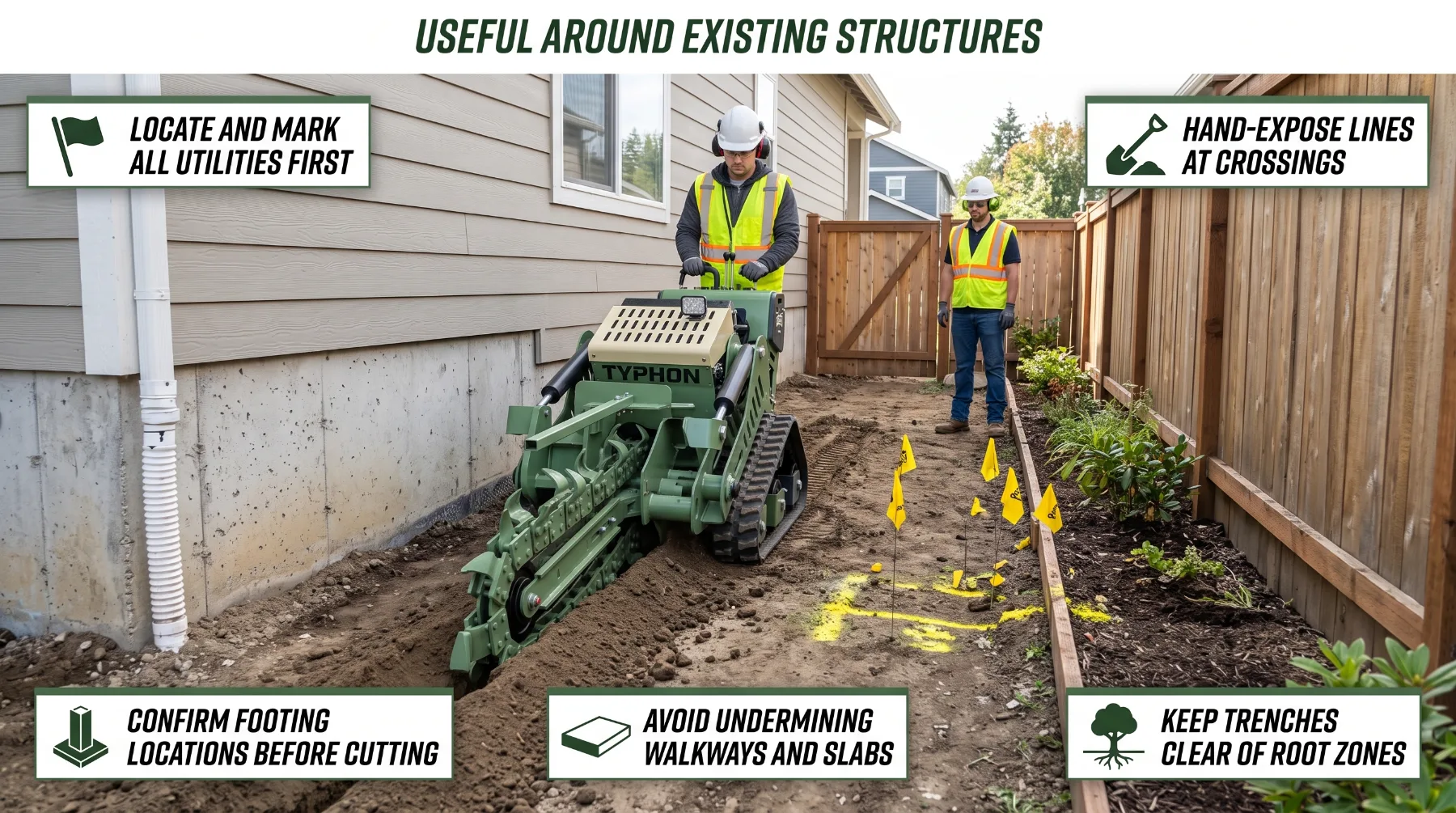
Residential and commercial projects often require excavation close to structures that must stay undisturbed. Foundations, patios, walkways, driveways, fences, retaining walls, and established landscaping all limit where and how equipment can work. Compact trenchers give operators more flexibility in these conditions.
A compact machine can work along a building, follow a fence line, or cut between planting beds with less risk of contact than larger equipment. Its narrow cut also limits disturbance to the soil supporting nearby surfaces.
Working near structures still demands care:
- Confirm foundation and footing locations before trenching near a building, and follow project requirements for excavation near footings.
- Watch for shallow features such as irrigation lines, landscape lighting wire, drain lines, and sprinkler heads.
- Protect tree roots by keeping trenches as far from trunks as practical. Reroute or hand dig near critical root zones.
- Avoid undermining surfaces such as sidewalks, slabs, and pavers by keeping the trench a safe distance from their edges.
- Plan crossings under driveways or walkways, where boring or another method may be more appropriate than open trenching.
Utility locating is essential on every job. Contact your local utility locating service before digging and wait for lines to be marked. Private lines, such as service lines to detached buildings, irrigation, and lighting, may not be marked by public locators. Ask the property owner about any private utilities, and hand-expose marked lines where the route crosses or runs close to them. Never trench directly over a marked utility.
Key takeaway: Compact trenchers offer flexibility near buildings, landscaping, and fixed features, but locate all utilities, confirm structure locations, and protect surrounding surfaces before cutting.
Maneuverability Supports Short Routes
Confined jobsites rarely provide long, straight trench runs. Routes may be short, include several turns, and pass around buildings, landscaping, or other obstacles. A compact trencher can make these conditions easier to manage by turning in tight spaces, repositioning quickly between trench sections, traveling along narrow paths, and stopping precisely near structures, crossings, and tie-in points. These capabilities can reduce unnecessary travel and make short, interrupted trench runs more efficient.
Maneuverability still requires careful operation. Maintain safe clearance around the machine and plan each movement before repositioning, especially where walls, fences, vehicles, or other fixed objects create pinch points. When approaching corners, remember that trenchers generally cut most efficiently in straight lines. Cutting each straight section separately and finishing tight corners by hand can produce cleaner trench walls and reduce unnecessary stress on the digging chain.
Key takeaway: A compact trencher handles short, obstructed routes and frequent repositioning well, but operators must keep safe clearance around the machine and stop the chain before every move.
Ground Conditions Affect Cutting
A smaller trencher does not eliminate the effects of soil conditions. Ground type can change cutting resistance, chain wear, and trenching speed, and conditions may change quickly along the same route. Loose or sandy soil generally cuts easily but may collapse back into the trench, while moist clay can cut well but stick to the teeth and auger. Compacted soil requires more cutting force, gravel and rocky ground increase tooth wear and impact loads, and roots can slow the chain or become caught in the cutting system.
Choose the chain and teeth according to the ground you expect to encounter. Cup-style teeth are generally suited to softer soil, while rock-style teeth are better for compacted or rocky conditions. If soil changes along the trench route, a combination setup may provide more flexibility. Adjust your operating technique as conditions change by advancing slowly through hard or rocky ground and allowing the chain to cut instead of forcing the machine forward. If the chain stalls, bogs down, or begins to bounce, stop and assess the ground before continuing. Remove packed clay and other buildup from the chain and auger regularly.
Inspect the cutting chain before each shift with the engine off and the boom lowered. Look for worn or missing teeth, proper chain tension, and damage to sprockets or idlers. A sharp, properly adjusted chain cuts more efficiently and reduces unnecessary strain on the trencher. Regular inspection also helps identify wear before it affects trench quality or leads to unexpected downtime.
Key takeaway: Clay, compacted soil, gravel, roots, and rock all change cutting resistance, so match the chain and teeth to the ground and adjust cutting speed to the conditions.
Plan the Work Area First
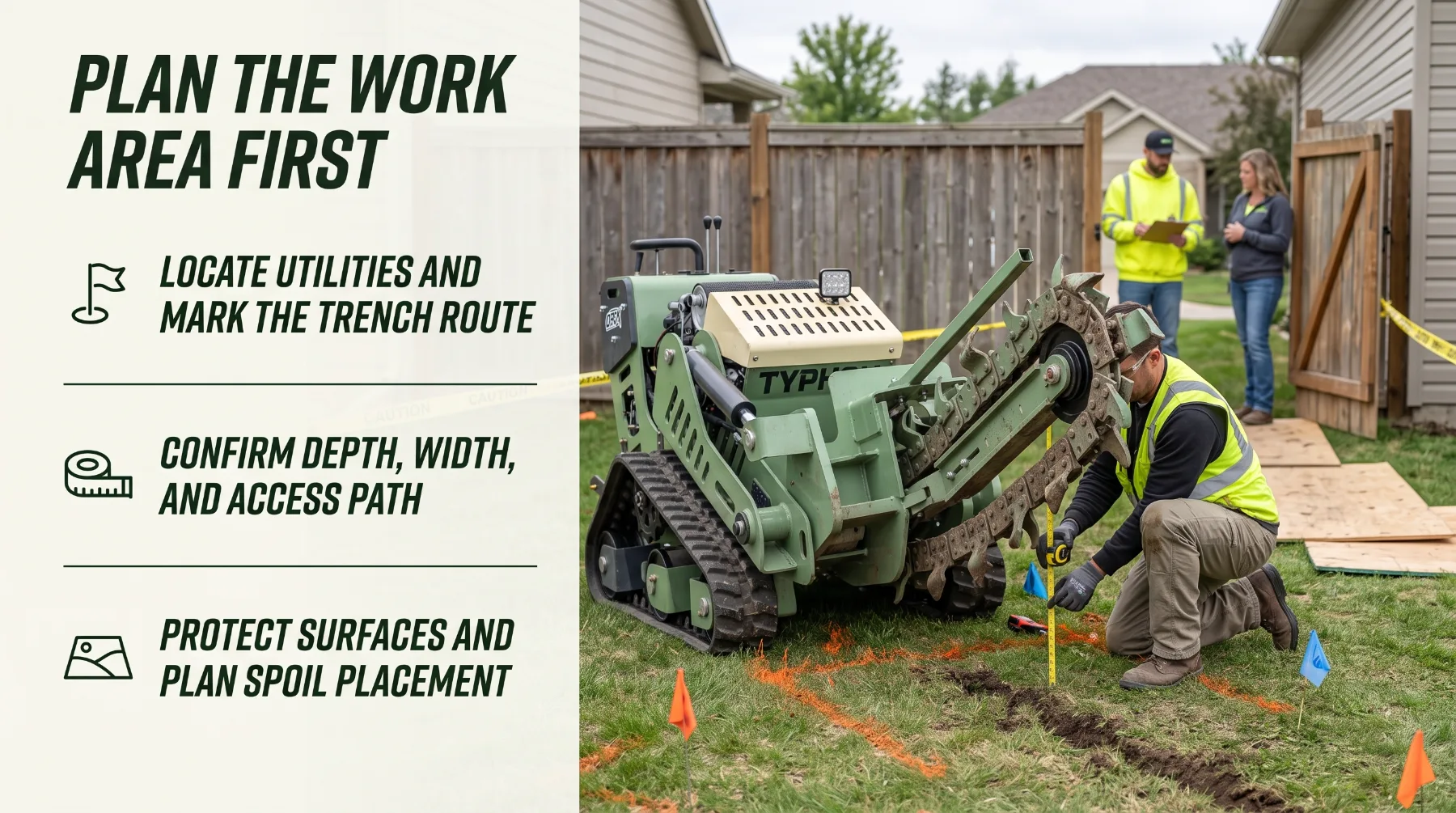
Good planning is the foundation of efficient confined-area trenching. Before cutting begins, walk the entire site and identify the trench route, required depth and width, drainage grade requirements, and the machine's access path. Contact the appropriate utility locating service, confirm existing marks, and identify private lines with the property owner. Mark the trench route with paint or flags, including turns and crossings, and note potential hazards such as foundations, slopes, soft ground, tree roots, overhead obstructions, and trench crossings.
Plan where excavated soil will be placed and how the spoil will be protected from falling back into the trench or blocking access. Protect lawns, pavers, and other finished surfaces with mats or plywood where necessary. Also plan the work sequence so the machine can complete the farthest sections first and back out without repeatedly crossing completed work. A clear access and cutting plan reduces unnecessary repositioning, protects surrounding property, and helps keep the excavation organized.
Communicate the plan with the crew and property owner before work starts. Keep children, pets, and bystanders away from the operating area, and use barriers or caution tape if a trench will remain open. As trench depth increases, follow applicable excavation and trench-safety requirements, and never allow anyone to enter an unprotected trench. Taking time to plan utilities, access, spoil placement, surface protection, and the work sequence before cutting can prevent avoidable delays and safety problems.
Key takeaway: Identify the trench route, required depth, access path, and surrounding hazards before cutting begins, so the excavation stays aligned and machine movement stays to a minimum.
Conclusion
A compact trencher provides controlled narrow excavation in areas where larger equipment may have limited access, using its small dimensions, maneuverability, and narrow cutting system to work through gates, paths, and restricted spaces around buildings and landscaping. Before operation, contractors should verify underground utilities, including private lines, irrigation, and lighting, measure access and overhead clearances, mark the trench route and required depth, width, and grade, and assess soil conditions, roots, rock, slopes, and soft ground. Cutting chain and teeth should match the ground conditions, while chain tension, sprockets, idlers, and tooth condition should be inspected before work. Ground protection such as mats or plywood can help protect lawns and finished surfaces, while spoil should be placed away from trench edges, walkways, and landscaping. During operation, the cutting chain should be stopped before repositioning, adequate clearance should be maintained around fixed features, and bystanders, pets, and other workers should remain outside the moving chain area. Matching the trencher to the site access, trench requirements, ground conditions, and planned work sequence supports accurate excavation while minimizing unnecessary ground disturbance.
Frequently Asked Questions
Why use a compact trencher in confined areas? A compact trencher's smaller dimensions make access and positioning easier in restricted construction spaces. It can often reach work areas through narrow gates, paths, and spaces between structures where larger equipment may not fit. Its maneuverability also helps operators follow planned trench routes while limiting unnecessary disturbance to surrounding surfaces.
Can a compact trencher create narrow trenches? Yes. Compact trenchers are designed for continuous, narrow excavation using a suitable cutting chain or digging system. Narrow trenches reduce the amount of soil removed and can lower spoil volume and restoration work after installation. The final trench width and depth depend on the machine, cutting system, soil conditions, and project requirements.
What affects trencher performance in confined areas? Machine dimensions, required trench width and depth, ground conditions, access, and operator control all affect performance. Tight spaces may limit positioning and turning, while hard, wet, or rocky soil can increase cutting resistance. Careful route planning and a chain matched to the ground conditions help support consistent trenching and accurate results.
Are compact trenchers useful for residential work? Yes. Compact trenchers are useful for residential irrigation, drainage, utility lines, landscape lighting, and other narrow excavation projects. Their smaller size can reduce disturbance around lawns, driveways, fences, and landscaping. Before digging, underground utilities should be properly located and marked, and the trenching plan should match the required depth, width, and site conditions.
Equipment Guidance
Need help choosing equipment for your next job?
Contact KONSTRUCTZ support and get practical guidance before comparing machines, attachments, or jobsite requirements.Contact SupportReader Comments
Join the equipment discussion
Related Posts
No published comments yet.