
Table of Contents
Stone crushing projects often involve mixed materials such as reinforced concrete, hard granite, and demolition debris that vary greatly in size and shape. Choosing a crusher based only on its advertised capacity can lead to frequent blockages, inconsistent production, and delays when the actual feed exceeds the machine’s practical limits. Evaluating the largest incoming pieces and the required output gradation helps determine whether a crusher can handle the job efficiently.
Feed opening dimensions, maximum recommended feed size, material hardness, and crushing chamber design all influence performance. The opening size does not mean every piece of similar width will feed reliably, particularly when slabs bridge across the chamber or rounded boulders fail to engage the jaws. Actual throughput also depends on material characteristics, feed consistency, discharge settings, wear-part condition, and whether screening or secondary processing is required.
Reliable production starts with measuring the largest pieces, removing excess soil and clay, and breaking oversized material to a suitable size before feeding. Steady loading helps prevent the chamber from alternating between overload and underfeeding, while screening and return conveyors can improve final gradation. Operators should follow manufacturer recommendations for feed limits and machine settings, and use proper shutdown and lockout procedures before addressing blockages.
Understanding Crusher Feed Opening Size
The feed opening is the entrance through which raw stone enters the crushing mechanism. On a jaw crusher, it's the gap at the top of the chamber between the fixed jaw and the moving jaw, usually described by its width and depth, or gape. On an impact crusher, it's the inlet that guides material toward the rotor. On a cone crusher, it's the opening between the mantle and concave at the top of the chamber. Whatever the design, these dimensions set a firm limit on the size of material the machine can accept.
That limit shapes everything that happens before crushing begins. When the opening suits the debris your work produces, loaders and excavators can place material directly into the hopper with little preparation. When the opening is too small, every oversized piece has to be broken down, sorted out, or set aside for separate handling. That extra work adds labor, fuel, and equipment time to every batch, and it can turn a productive crushing day into one spent mostly on preparation.
Contractors should compare the opening dimensions with the largest expected rock pieces rather than relying only on average feed size. Average figures hide the outliers that cause the most trouble. A debris pile may contain mostly manageable chunks, yet a small share of large slabs, footing sections, or boulders can control the pace of the whole job, as the grain elevator crew discovered. Walk several piles, measure the biggest pieces you find, and note their thickness as well as their width. Those measurements give a far more honest picture of how much pre-breaking the crew will face.
It's also worth remembering that a crusher's overall size says little about its feed opening. A machine can look substantial on its trailer and still have an opening that's too small for your typical debris. Review the published opening dimensions for each model you're considering, and compare them directly with your measurements instead of judging by appearance.
Key takeaway: The feed opening sets a firm limit on the material a crusher can accept, so compare its dimensions with the largest expected pieces at your jobsites, not the average feed size.
Maximum Feed Size and Rock Dimensions
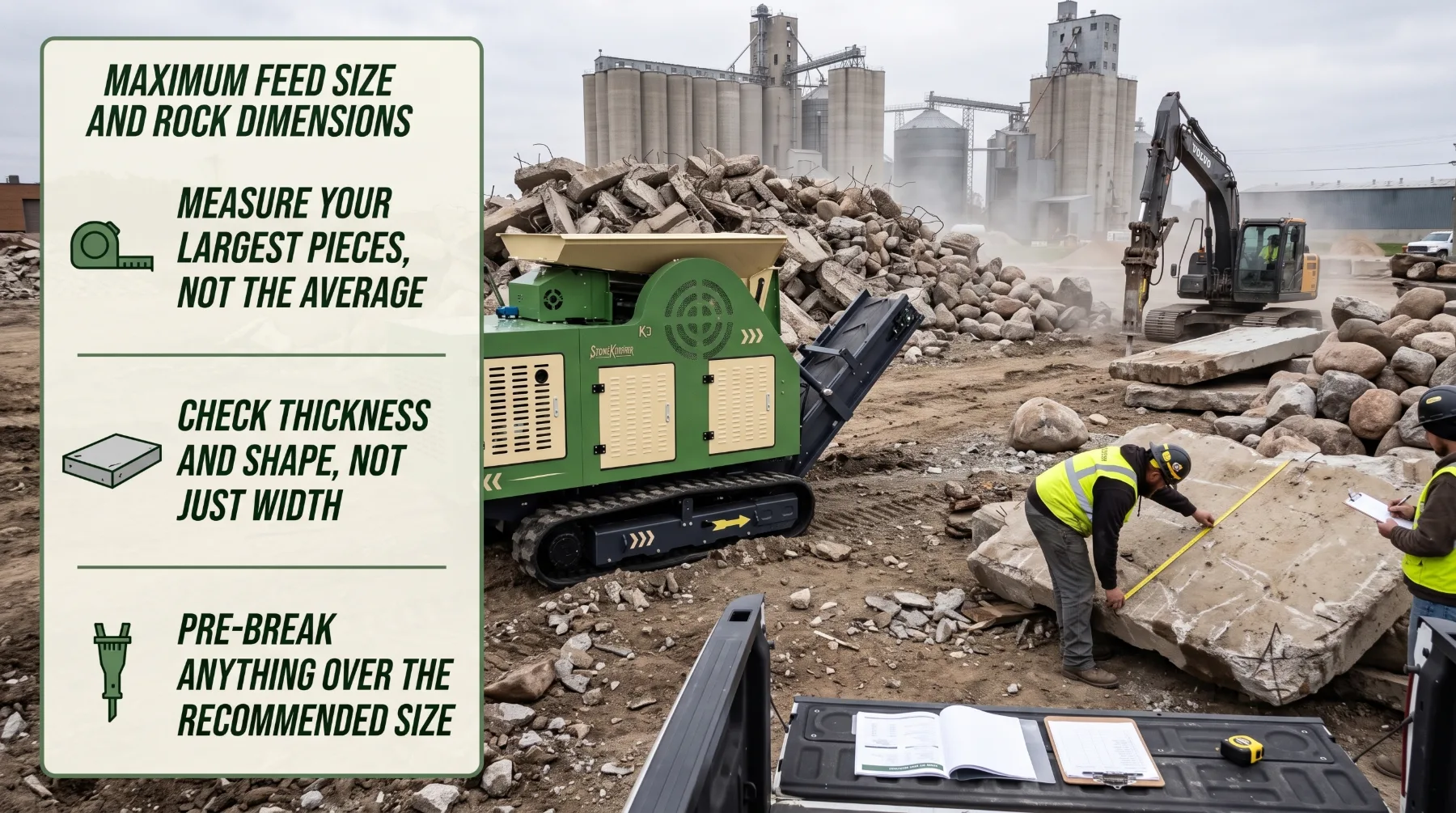
Maximum feed size refers to the largest material dimension the crusher is designed to accept under specified conditions. It's closely related to the feed opening but not the same figure. Many manufacturers recommend a maximum feed size well below the full width of the opening, often around 80 percent, so rock can enter cleanly and be gripped properly by the crushing surfaces. A crusher with a 30-inch opening, for example, may be rated for pieces up to about 24 inches for reliable feeding. Always follow the published recommendation for the specific machine rather than assuming that anything narrower than the opening will work.
Oversized rocks create several problems. They can bridge across the opening, resting on both crushing surfaces without dropping into the chamber. They can obstruct material flow behind them, causing the hopper and feeder to back up. They can also place excessive force on the drive, bearings, and frame if they wedge deep in the chamber. Each of these situations interrupts production, and each requires a careful, controlled response to clear. Breaking oversized material before processing, usually with a hydraulic breaker or another approved method, prevents most of these problems before they start.
Irregular rock shapes can affect feeding even when a piece appears to fit through the opening. Flat, slabby concrete may pass the width test yet turn sideways and bridge across the jaws. Long, narrow pieces can tilt and jam, or slip through without breaking properly. Round boulders may roll on top of the chamber instead of being drawn down and gripped. Reinforced concrete adds another complication, since protruding rebar can snag on the feeder or catch across the chamber. Trim long rebar tails before feeding, and follow the manufacturer's guidance on steel content.
Measuring rock dimensions correctly helps you plan. Measure the longest dimension of each large piece, check its thickness, and note its shape. Compare those figures with the recommended maximum feed size, not the opening itself. The result shows how much material the crew can load directly and how much must be prepared first, which feeds directly into labor planning and scheduling.
Key takeaway: Maximum feed size is usually smaller than the full feed opening, so measure the length, thickness, and shape of your largest pieces and pre-break anything that exceeds the manufacturer's recommendation.
Material Hardness and Crusher Performance
Not all stone behaves the same way in a crushing chamber. Hard, abrasive rock places different demands on crushing components than softer or more friable material. Granite, basalt, and quartz-rich fieldstone resist fracture and require more crushing force. Limestone, sandstone, brick, and weathered concrete generally break more easily. That difference affects how quickly material moves through the chamber and how fast wear parts wear out.
Several material properties work together to influence throughput and wear. Rock strength determines how much force is needed to break each piece. Abrasiveness, usually tied to silica or quartz content, controls how quickly jaw dies, blow bars, and liners wear away. A rock can be moderately hard yet highly abrasive, so both properties matter when estimating performance and operating costs. Moisture adds another layer, since wet, sticky material can cling to the hopper, feeder, and chamber walls and reduce the space available for crushing. Particle shape also plays a role, because slabby or elongated pieces feed less predictably than blocky stone.
A crusher that performs efficiently on one material may produce a lower rate when processing tougher or more difficult feed. A machine that easily meets its rated output on clean limestone may run noticeably slower on glacial granite, and production may drop again if that granite arrives wet or mixed with clay. Reinforced concrete can vary widely, from thin sidewalk panels that break readily to thick, high-strength footings that resist crushing. Planning for the hardest material on the job, not the easiest, gives you a schedule that holds up.
Hardness and abrasiveness also shape maintenance planning. Abrasive rock can shorten wear part life significantly, which changes product size as discharge gaps open and raises operating costs. Keep spare wear parts on hand for abrasive jobs, measure crusher settings more often, and budget for more frequent replacements. Matching crusher type and wear parts to your typical material protects the machine and keeps output consistent from the first ton to the last.
Key takeaway: Rock strength, abrasiveness, moisture, and shape influence both throughput and wear, so plan production and maintenance around the toughest material on the job rather than the easiest.
Preventing Blockages and Maintaining Capacity
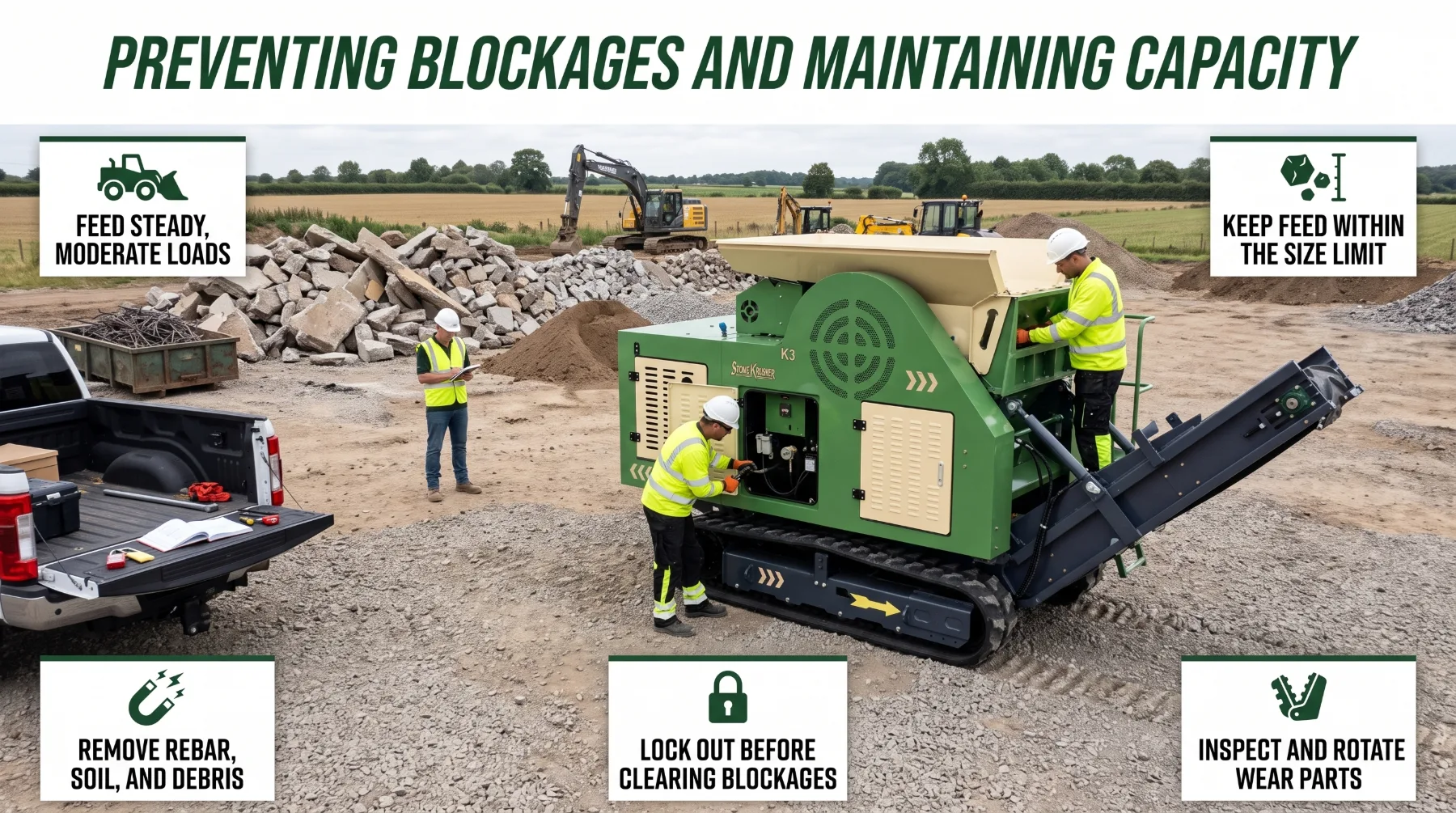
Consistent feeding helps the crushing mechanism work efficiently. When the loading operator places moderate amounts of suitable material at a steady rhythm, the chamber stays evenly filled, rock breaks against rock as well as against the crushing surfaces, and the machine settles into productive operation. Full buckets dropped in quick succession, followed by long pauses to sort material, creating the overload-and-starve cycle that cuts output and invites blockages.
Operators should follow the machine's loading procedure, which typically covers loading direction, bucket size, drop height, and feeder speed. Place material low in the hopper rather than dropping it from height, since heavy impacts damage the feeder and push material into the chamber in surges. Use the feeder speed control to match the chamber level, and take advantage of automatic load or level controls where the machine provides them. Coordinate with the crusher operator using agreed signals, so feeding slows or stops whenever the chamber fills, the engine begins to lug, or the discharge conveyor backs up.
Avoiding oversized or unsuitable material is the most effective way to prevent blockages. Keep feed within the recommended maximum size, trim protruding rebar, and remove wood, soil, plastic, and other non-crushable debris before loading. Use magnetic separation where equipped to pull loose steel from the product, but don't rely on it to catch large tramp metal before it reaches the chamber.
Inspecting wear components regularly protects capacity over the life of the job. As jaw dies, blow bars, and liners wear, crushing efficiency drops and discharge gaps open, which changes product size and can reduce throughput. Inspect crushing surfaces, cheek plates, grizzly bars, and feeder components at regular intervals, measure the crusher setting after wear part changes, and rotate or replace parts according to the manufacturer's instructions. Record findings in a maintenance log so wear patterns are easy to track.
When a blockage does occur, clearing it must follow the manufacturer's shutdown and isolation procedures, never improvised methods while the equipment is operating. Stop the feeder and crusher, shut down the machine, and apply lockout according to the manufacturer's instructions before anyone approaches the hopper or chamber. Some designs offer hydraulic functions that open the setting to release material, and those should be used only as the manual directs. Never use hands, feet, or a bar to clear material from a running crusher, never climb onto the hopper or feeder during operation, and never stand where ejected rock could strike you. Crushing also generates dust that can contain respirable crystalline silica, so use water suppression where equipped and provide respiratory and hearing protection where required.
Key takeaway: Steady, controlled feeding, careful removal of oversized and unsuitable material, and regular wear part inspection keep capacity high, while every blockage must be cleared only through the manufacturer's shutdown and isolation procedures.
Matching Feed Size With Production Needs
Selecting a crusher involves balancing the size of the incoming rock with the size of the finished aggregate the project requires. Every crushing stage achieves a practical reduction ratio, which is the relationship between the size of the feed and the size of the product. Large feed and small products can sit too far apart for one crusher to bridge efficiently. Trying to force that gap, usually by closing the discharge setting far below the recommended range, packs the chamber, reduces capacity, and increases stress on the machine.
Material that is too large may need primary breaking before it reaches the crusher. A hydraulic breaker on an excavator is the most common tool for reducing oversized concrete and boulders on a contractor's site, and it lets the crusher focus on the work it was designed to do. Planning that step from the beginning, with equipment and an operator assigned to it, keeps the crusher supplied with suitable feed instead of waiting while oversized material is handled.
Inconsistent feed can cause uneven production. When a load of large chunks arrives right after a load of small material and fines, the chamber alternates between overloaded and underused, and the product gradation shifts from one hour to the next. Sorting material into separate piles by size and type, then blending feed in a steady rhythm, helps the crusher run evenly and produce a more uniform product. Removing fines and soil ahead of the chamber through a grizzly section or screening bucket frees crushing capacity for the rock that actually needs reduction.
Operators should also consider whether screening, recirculation, or additional crushing stages are needed to meet the required gradation. A screen after the crusher separates finished product from oversized pieces, and a return conveyor can send those pieces back for another pass. A second crushing stage, such as an impact or cone crusher following a jaw, can refine product size and shape when the specification calls for something finer than a single primary crusher can deliver efficiently. Review the project's gradation requirements early, confirm them with the engineer or customer, and design the crushing setup around them rather than discovering the gap after the first sieve test.
Key takeaway: Balance incoming rock size with the required finished aggregate size, plan primary breaking for oversized material, keep feed consistent, and add screening, recirculation, or additional stages when the gradation requires it.
Conclusion
Feed opening size determines the material a stone crusher can accept, while rated capacity indicates its potential processing rate under specified conditions. Both figures should be evaluated against actual jobsite materials and production requirements. Comparing the opening with the largest expected pieces, including their thickness and shape, helps identify pre-breaking needs and reduce the risk of bridging or blockages. Published capacity should be treated as a starting point because rock strength, abrasiveness, moisture, feed consistency, and productive hours all affect actual throughput. Before crushing, contractors should measure the largest feed pieces, identify the hardest and most abrasive materials, and estimate realistic production based on available operating time. The required finished aggregate size should also be confirmed to determine whether screening, a return conveyor, or an additional crushing stage is needed. Removing unsuitable material and excess soil or fines, maintaining steady feed, and coordinating loading signals between operators help support consistent production. Wear parts and crusher settings should be inspected before startup, while the manufacturer's blockage-clearing and lockout procedures must be reviewed with the crew. Matching feed size, material characteristics, crusher capacity, and output requirements helps protect equipment, maintain production schedules, and deliver aggregate that meets project specifications safely and efficiently.
Frequently Asked Questions
Why is feed opening size important? Feed opening size determines the size of material that can enter the crushing chamber, which helps prevent oversized feed from causing blockages. It also shapes how much preparation your crew faces before crushing begins. When the opening suits your typical debris, material can be loaded directly with less pre-breaking. Compare the opening with the largest pieces at your jobsites, and remember that the manufacturer's recommended maximum feed size is often smaller than the opening itself.
Does a larger feed opening always mean higher production? No. A larger opening accepts bigger pieces, but throughput also depends on crusher design, material hardness, feed consistency, the closed side setting, and the required finished aggregate size. A machine with a large opening can still produce less than expected on hard, abrasive rock or with irregular loading. Evaluate the opening and capacity together, using realistic output estimates for your actual materials.
What can reduce a crusher's actual capacity? Hard or abrasive material, oversized or slabby feed, inconsistent feeding, excessive moisture and clay, worn crushing surfaces, and unsuitable operating settings can all reduce throughput. A tighter setting for finer products also lowers output. Scalping fines, pre-breaking oversized material, maintaining a steady feed rate, and inspecting wear parts regularly help keep production closer to the crusher's practical potential.
How can operators prevent feed blockages? Keep material within the specified feed size limit, trim protruding rebar, remove wood, soil, and other unsuitable debris, and maintain consistent, moderate loading placed low in the hopper. Coordinate with the crusher operator so feeding slows when the chamber fills. If a blockage occurs, follow the manufacturer's safe shutdown, lockout, and clearing procedures, and never use hands, feet, or a bar on a running crusher.
Equipment Guidance
Need help choosing equipment for your next job?
Contact KONSTRUCTZ support and get practical guidance before comparing machines, attachments, or jobsite requirements.Contact SupportReader Comments
No published comments yet.