
Table of Contents
- Understanding the Control Layout
- Control Familiarity and Route Planning
- Maintaining a Clear Field of View
- Coordinating Travel and Attachment Movements
- Safe Operation in Restricted Spaces
- Maneuvering in Restricted Spaces
- Using a Spotter When Visibility Is Limited
- Managing Loads and Stability
- Control Inspection and Operator Training
- Conclusion
- FAQs
Working in confined spaces requires careful coordination between machine movement, load handling, and awareness of nearby obstacles. Tri-loaders support landscaping, material transport, and excavation tasks where narrow access and limited clearance can restrict larger equipment. Even with agile handling, small steering or positioning errors can damage structures, disturb materials, or endanger nearby workers.
Accurate maneuvering depends on clear visibility and predictable control response throughout each movement. Operators must monitor the travel path, attachment position, load, and surrounding work area while accounting for blind spots. Unfamiliar control patterns or obstructed views can make precise movements difficult, particularly when turning or placing materials near people and structures.
Reliable performance starts with learning the machine's control layout, inspecting visibility aids, and planning a clear route through the work area. Smooth control inputs, appropriate travel speeds, and loads kept within rated limits help maintain stability and positioning accuracy. When visibility is restricted, a trained spotter can guide movements and help prevent contact with obstacles or nearby personnel.
Understanding the Control Layout
Control layouts vary between tri-loader models and configurations. Travel controls, steering, lift-arm movement, bucket tilt, and auxiliary hydraulics may sit in different positions or respond to different hand and foot motions. One machine may combine travel and steering into a single lever, while another separates them. Some use joysticks, others use levers or pedals, and the direction each control moves can differ from one machine to the next.
Assuming a new machine works like the last one is one of the most common causes of unexpected movement. An operator who pushes a lever expecting the bucket to tilt may instead lift the arms or move the machine forward. On an open site, that might only cost time. Near a wall, a parked vehicle, or a coworker, it can cause serious damage or injury.
Take time to learn the exact control pattern before you operate. Read the operator's manual, study the control decals in the operator station, and identify every function, including the parking brake, hydraulic lockout, horn, and emergency stop. Then practice each movement slowly in a clear, open area with no load. Build familiarity at low speed before moving to tighter spaces or heavier material.
Pay attention to control sensitivity as well. Some machines respond sharply to small inputs, while others need a fuller stroke. Understanding how much movement each control produces lets you make the small, precise adjustments that accurate placement demands.
Key takeaway: Control layouts differ between tri-loader models, so learn the exact pattern and response of each machine in an open area before working in tight spaces or near people.
Control Familiarity and Route Planning
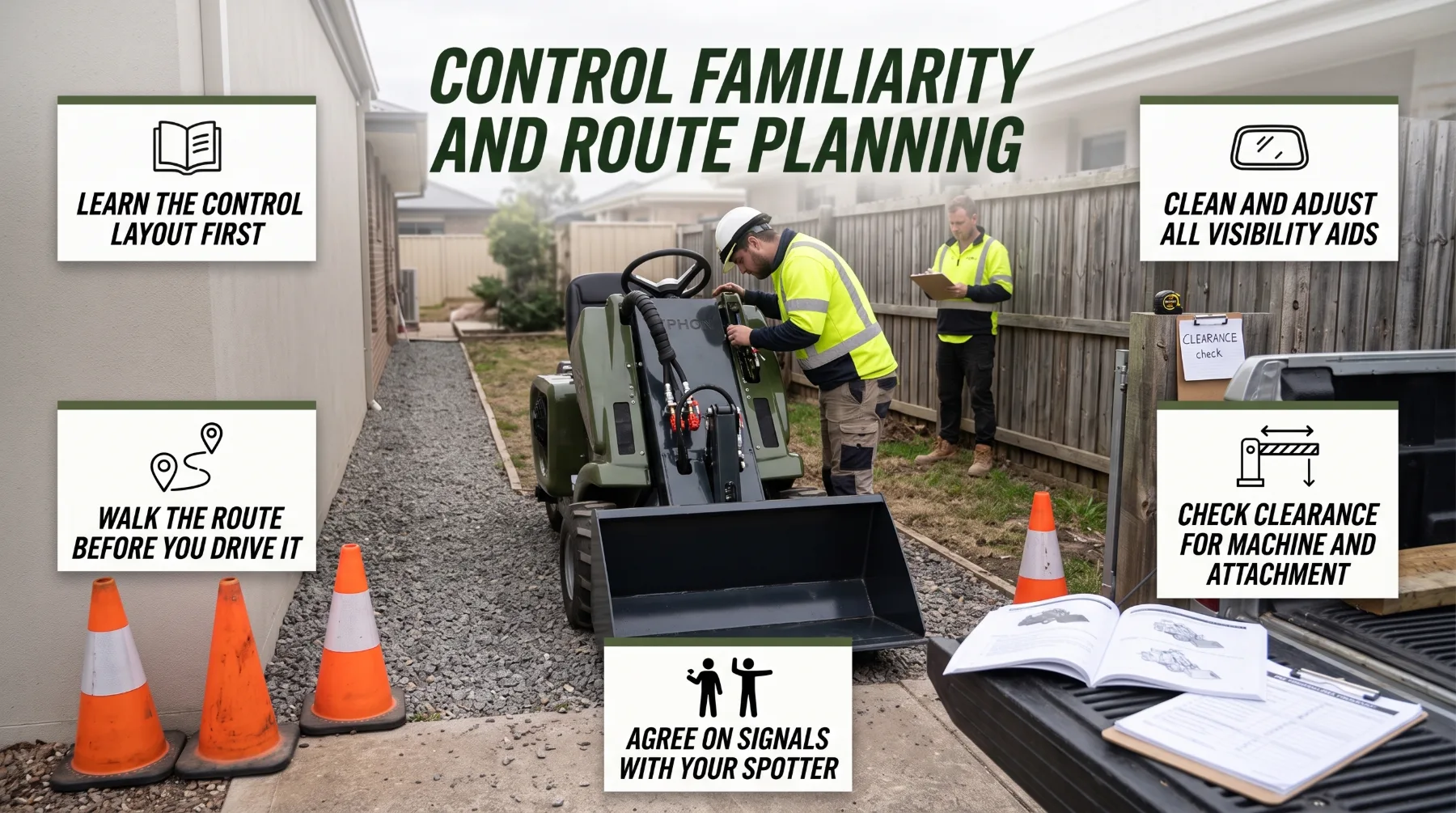
Before operating a TYPHON tri-loader, familiarize yourself with the control layout, function decals, hydraulic lockout, and attachment coupler indicators. Review the operator's manual and complete the pre-operation checklist to confirm that the machine and attachment are ready for use. Check mirrors and other visibility aids, and make sure you understand the controls before starting the shift.
Route planning is especially important when working in compact residential areas, landscaping projects, or narrow access passages. Walk the intended route to identify tight turns, uneven surfaces, obstacles, and overhead or side clearance restrictions. Measure gate openings and passage widths against the machine's dimensions, including the attachment, and remove obstructions before moving into the work area.
Establish clear communication with a spotter before entering restricted spaces. Agree on hand signals, maintain visual contact, and stop immediately if the spotter moves out of sight. Keep the attachment in the recommended low travel position, move at a controlled speed, and avoid proceeding until the route is clear and the next movement is understood.
Maintaining a Clear Field of View
You can only steer around what you can see. The operator should keep a clear view of the travel route, the attachment, nearby workers, and obstacles as fully as the machine design allows. Every tri-loader has areas the operator cannot see directly, and those blind spots change as the attachment moves and the machine turns.
Raised buckets and bulky attachments are among the biggest obstacles to forward visibility. A full bucket carried high can block the ground directly ahead, hiding curbs, holes, tools, and people. Large loads such as stacked material or pallets can create the same problem. Carrying the attachment low, in the manufacturer's recommended travel position, usually opens up the forward view and improves stability at the same time.
Keep every visibility aid clean and working. Mirrors, cameras, windows, and work lights should be checked before each shift and cleaned whenever dust, mud, or moisture builds up. Adjust mirrors from the operating position so they show the areas you actually need to watch. When work continues into early morning or evening, confirm that lights are bright enough to show the travel path and the attachment clearly.
When something blocks your view, slow down or stop. Look over your shoulder before reversing, sound the horn where required, and never move toward an area you can't see. If the view can't be improved by changing the load position or route, use a trained spotter.
Key takeaway: Carry attachments low, keep mirrors, cameras, windows, and lights clean and adjusted, and never move toward an area you cannot clearly see.
Coordinating Travel and Attachment Movements
Loading, carrying, and placing material often call for travel, lifting, and tilting to happen close together. An operator may drive toward a pile, lower the bucket, fill it, lift, reverse, turn, and dump within seconds. The smoother these movements fit together, the more accurate and controlled the work becomes.
Abrupt inputs create sudden changes in direction and load position. Jerking the lift arms upward can throw material from the bucket. Snapping into a turn while carrying a raised load can shift the machine's balance. Stopping hard can make the load surge forward. Each of these makes precise placement harder and raises the risk of losing control.
Use deliberate, gradual control inputs. Start each movement gently, build speed once the machine and load are moving smoothly, and ease to a stop before changing direction. Avoid combining sharp travel and attachment movements unless you are fully familiar with how the machine responds. As your experience grows, you can blend functions into one continuous motion, but accuracy should always come before speed.
Slow down when approaching structures, pallets, landscaping features, fresh plantings, finished surfaces, or any area that requires careful placement. The final few feet of any approach deserve the most attention. Creep into position, make small adjustments, and confirm alignment before lowering or dumping the load.
Key takeaway: Smooth, deliberate control inputs reduce sudden shifts in direction and load position, so slow down and make small adjustments when approaching structures or placement areas.
Safe Operation in Restricted Spaces
Operating a tri-loader in a narrow passage requires careful control of machine movement and attachment position. Carry the bucket or other attachment low in the manufacturer's recommended travel position, travel slowly, and allow sufficient clearance from walls, fences, gates, and nearby structures. Avoid sharp turns or sudden control inputs that could bring the machine or attachment into contact with surrounding objects.
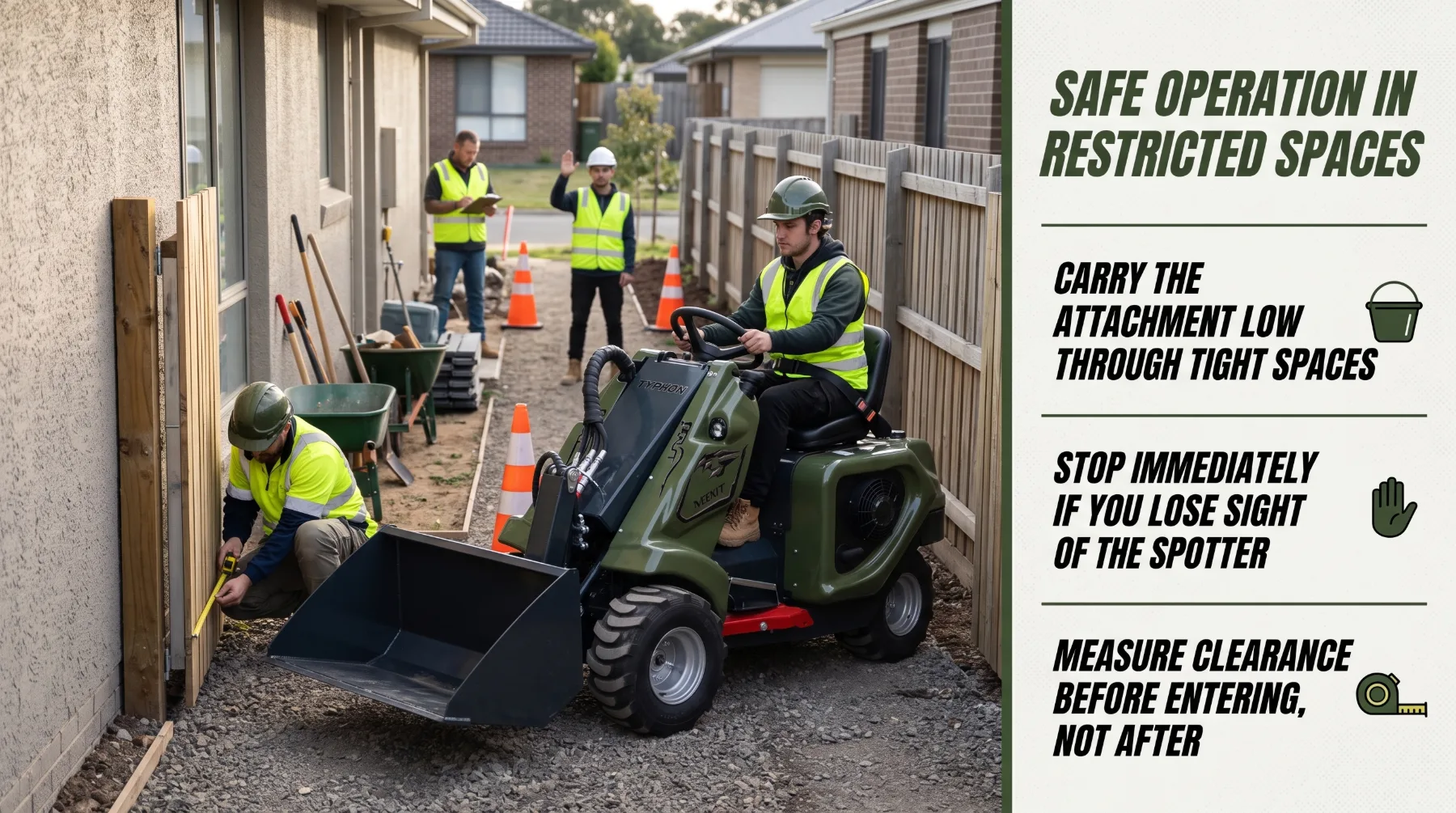
A trained spotter can help monitor blind spots and guide the machine through restricted access areas. Maintain clear communication throughout the maneuver and stop immediately if visual contact is lost or a signal is unclear. The operator should never continue moving based on assumptions about the spotter's position or the available clearance.
Measure the access route before entering, accounting for the machine's overall width, attachment dimensions, turning space, and any protruding components. Confirm that the ground is firm enough for travel and that tools or materials are kept outside the designated route. Combining accurate clearance checks with controlled movement helps reduce collision risks and supports safer operation in confined work areas.
Maneuvering in Restricted Spaces
A tri-loader's compact dimensions let it work through gates, along narrow side yards, between buildings, and inside spaces where full-size equipment can't operate. Fitting into those areas safely depends on checking clearance for the machine and the attachment together, not just the machine body.
Attachments often extend beyond the machine's width or length, and their reach changes as the arms rise and the bucket tilts. A machine that clears a gate with the bucket low may strike the post when the bucket is raised or angled. Turning also sweeps a wider path than straight travel, so the rear and corners of the machine can contact walls, fences, and parked equipment during a turn.
Plan each movement before you make it. Walk the route first and look for:
- Width restrictions: Gates, doorways, fence lines, and narrow paths where the machine and attachment must pass.
- Turning space: Areas where the full turning path, including the rear of the machine, can clear surrounding objects.
- Overhead obstacles: Low branches, eaves, beams, door frames, and overhead lines, especially when the arms are raised.
- Ground hazards: Soft soil, steps, curbs, holes, buried utilities, irrigation heads, and uneven surfaces.
- People and activity: Pedestrians, other trades, and areas where workers may walk into the machine's path.
Move slowly through tight areas and keep the attachment low unless the task requires otherwise. If the clearance looks marginal, stop and measure rather than guessing. Repositioning or choosing another route takes far less time than repairing damage to a structure or the machine.
Key takeaway: Check clearance for the machine and attachment together, walk the route to identify width, overhead, and ground hazards, and move slowly through tight areas.
Using a Spotter When Visibility Is Limited
Some tasks place the operator in a position where key areas simply can't be seen. Backing through a narrow gate, working near a building corner, placing material against a wall, or moving through an area with heavy foot traffic may all call for a second set of eyes. A trained spotter can guide the machine safely through these situations.
A spotter is only effective when communication is clear and both people agree on the plan. Before work begins, decide on hand signals or radio calls for stop, go, slow, left, right, raise, and lower. Confirm that the operator and spotter understand every signal in the same way. The stop signal should be simple, obvious, and obeyed immediately, no matter who gives it.
Spotter position matters as much as communication. The spotter should stand where the operator can see them at all times, outside the machine's travel path and well clear of the attachment's reach and any pinch points. A spotter should never walk backward in front of a moving machine or stand between the machine and a fixed object.
If the operator loses sight of the spotter, the machine stops. Movement resumes only when the spotter is visible again and gives a clear signal. This simple rule prevents most of the incidents that occur when guidance breaks down.
Key takeaway: Use a trained spotter when the view is restricted, agree on clear signals in advance, keep the spotter visible and out of the machine's path, and stop whenever sight is lost.
Managing Loads and Stability
The load affects nearly everything about how a tri-loader handles. A full bucket of material changes the machine's balance, steering response, stopping distance, and the operator's view. Heavy or bulky loads also magnify the effect of every turn, bump, and slope.
Keep every load within the machine's rated capacity. Material weight is easy to underestimate, since wet soil, gravel, crushed stone, and broken concrete weigh far more than mulch or dry topsoil. A bucket that looks only partly full can still be close to the limit. Estimate loads by weight rather than appearance, and reduce the load when handling dense material.
Carry loads in the manufacturer's recommended travel position, which is usually low and close to the machine. A low load keeps the center of gravity down, improves stability, and opens up the forward view. Raising the load only when you reach the placement area limits the time the machine spends in a less stable condition.
Avoid sudden turns, abrupt braking, and fast travel while loaded. Take extra care on slopes, soft ground, loose gravel, and uneven surfaces, which can unsettle the machine or cause a wheel to drop unexpectedly. Travel straight up and down slopes where the manufacturer's instructions allow, and avoid crossing a slope with a raised or heavy load.
Key takeaway: Keep loads within rated capacity, carry them low in the recommended travel position, and avoid sudden turns, hard braking, and unsuitable surfaces while loaded.
Control Inspection and Operator Training
Precise maneuvering starts before the machine moves. A thorough pre-operation check confirms that the controls respond correctly and that every safety and visibility feature works as intended. Inspect the machine on firm, level ground with the attachment lowered and the engine off before each shift.
- Controls: Check every lever, joystick, and pedal for sticking, looseness, damage, or inconsistent response. Confirm that each control returns to neutral when released.
- Hydraulics: Inspect hoses, fittings, and cylinders for leaks, abrasion, and seepage. Use a piece of cardboard rather than your hand to check for leaks, since pressurized fluid can cause serious injury.
- Attachment: Confirm the attachment is compatible, properly mounted, and securely locked in place.
- Visibility aids: Clean and adjust mirrors, cameras, windows, and lights.
- Safety equipment: Test the seat belt, horn, backup alarm, warning lights, parking brake, hydraulic lockout, and emergency stop.
- Tires or tracks: Check for damage, wear, and correct inflation or tension.
Once the engine is running, test each function slowly in a clear area before starting work. Report any defect and keep the machine out of service until it is corrected.
Training ties everything together. Operators should be trained on the specific model, the attachment configuration, and the site's procedures before beginning unfamiliar tasks. Training should cover the control layout, rated capacity, load handling, slope limits, visibility hazards, and spotter communication. Refresher training is valuable whenever an operator moves to a different machine or a new type of work.
Key takeaway: Inspect controls, hydraulics, attachments, visibility aids, and safety equipment before every shift, and make sure operators are trained on the specific machine and task.
Conclusion
Tri-loader maneuvering accuracy comes from the way control familiarity, visibility, load management, and smooth movement work together. Learning the exact control layout of each machine prevents unexpected movement, while a clear field of view lets the operator see the travel path, attachment, and surroundings. Deliberate control inputs keep loads steady during travel and placement, and careful route planning ensures the machine and attachment clear every gate, wall, and overhead obstacle.
A trained spotter fills the gaps where the operator's view falls short, and keeping loads low and within rated capacity protects the machine's balance. Thorough pre-operation checks and model-specific training make sure the machine responds predictably from the first movement of the day. When you know your controls, protect your view, and plan every move, your tri-loader delivers the precise, dependable performance that confined jobsites demand.
FAQs
Do all tri-loaders use the same control layout?
No. Control arrangements can vary by model and configuration. Operators should learn the specific machine's control pattern and practice in an open area before regular operation.
Why does attachment position affect visibility?
A raised or bulky attachment can block the operator's view of the travel path, the ground ahead, and nearby hazards. Carrying the attachment low usually improves both visibility and stability.
How can operators improve maneuvering accuracy?
Use smooth control inputs, reduce speed in tight spaces, keep loads low, and plan the movement before approaching the target area. Make small adjustments during the final approach.
When should a spotter be used?
A spotter should be used whenever visibility is restricted, such as when reversing through narrow openings or working near structures and people. Clear signals and safe spotter positioning must be agreed on before work begins.
What should be checked before operating a tri-loader?
Check the controls, hydraulics, attachment mounting, visibility aids, tires or tracks, and safety equipment such as the seat belt, alarms, brakes, and emergency stop.
Equipment Guidance
Need help choosing equipment for your next job?
Contact KONSTRUCTZ support and get practical guidance before comparing machines, attachments, or jobsite requirements.Contact SupportReader Comments
No published comments yet.